
What Are Planar Magnetic Headphones?
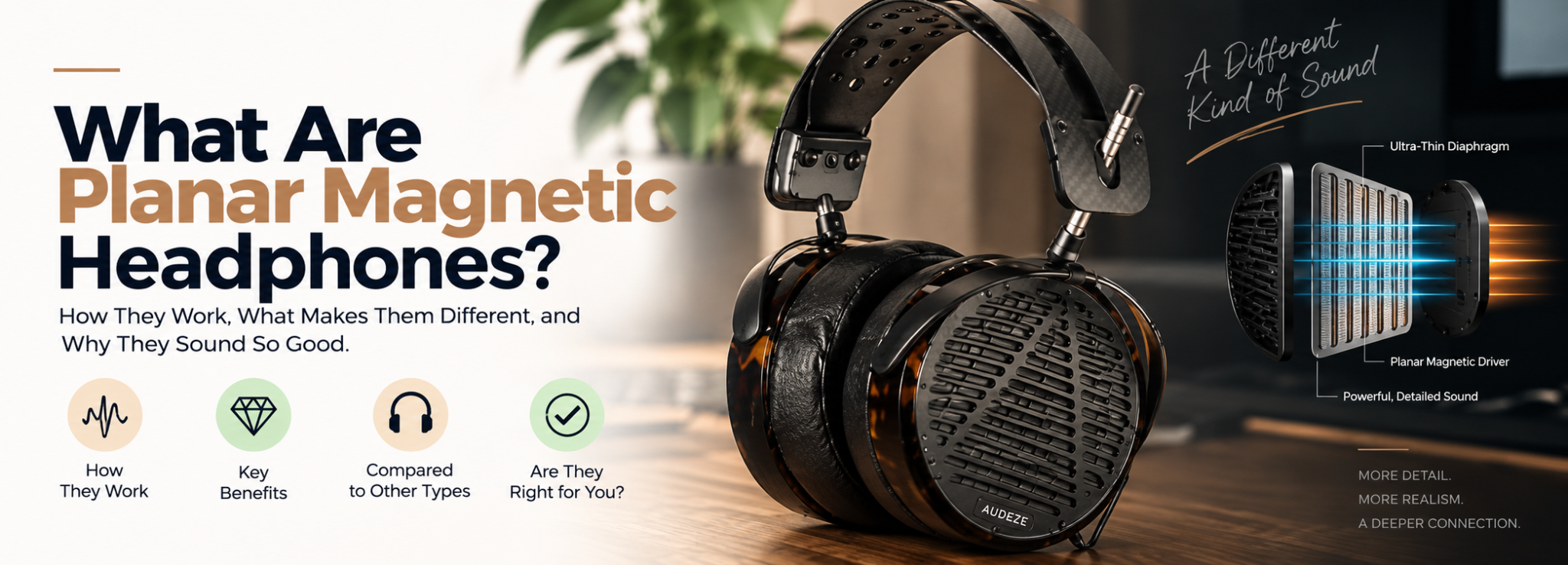
Planar magnetic headphones use a different type of driver technology from traditional dynamic headphones. They are generally bulkier than dynamic headphones, but their diaphragms can respond quickly to changes in the audio signal. Current planar magnetic models are also more comfortable than many of the older designs.
The arrangement of magnets on either side of the diaphragm looks somewhat like a sandwich, creating the planar magnetic driver. The headphones can have round or square earcups depending on the design.
Planar magnetic headphones are often known for their fast response, low distortion, detailed sound, and good instrument separation. However, the exact performance depends on the design and tuning of the specific headphone.
KEY TAKEAWAYS
01 — Planar magnetic headphones use a different type of driver technology from traditional dynamic headphones.
02 — The arrangement of magnets on either side of the diaphragm looks somewhat like a sandwich, creating the planar magnetic driver.
03 — Planar magnetic headphones are often known for their fast response, low distortion, detailed sound, and good instrument separation.
04 — Some planar magnetic headphones require more power than many conventional dynamic headphones.
QUICK ANSWER
What are planar magnetic headphones?
Planar magnetic headphones use a different type of driver technology from traditional dynamic headphones. They are generally bulkier than dynamic headphones, but their diaphragms can respond quickly to changes in the audio signal.
THE TECHNOLOGY
How Do Planar Magnetic Headphones Work?

Planar magnetic headphones use a thin diaphragm with conductive traces embedded in it. The diaphragm is positioned between two sets of oppositely aligned magnets.
These magnets are precisely cut and spaced on opposite sides of the diaphragm. When an audio signal passes through the conductive traces on the diaphragm, it creates a magnetic field that interacts with the permanent magnets on either side.
This interaction causes the diaphragm to move back and forth. As the diaphragm moves, it pushes the surrounding air and produces sound.
Because the magnetic force is distributed across the diaphragm, planar magnetic headphones can produce a fast and detailed response with low distortion. The large, flat diaphragm also helps the driver reproduce a wide range of frequencies, including bass, mids, and highs.
KEY FEATURES
Features
Design and Construction
The diaphragm in a planar magnetic driver is very thin and lightweight, with conductive traces embedded into it. It is positioned between an array of magnets that helps control its movement.
This construction makes the driver delicate, so planar magnetic headphones should be handled with care. Damage to the diaphragm or other parts of the driver can affect sound quality.
Size and Portability
Planar magnetic headphones are generally larger than many traditional dynamic headphones because their drivers and magnet arrangements require more space inside the earcups.
Earlier planar magnetic headphones were often particularly large and heavy. However, the technology has developed considerably, and smaller planar magnetic designs are now available in different form factors, including over-ear, on-ear, and in-ear headphones.
Transient Response
Planar magnetic headphones are known for their fast transient response. A faster transient response allows a headphone to reproduce sudden changes in an audio signal more quickly and clearly.
The thin diaphragm contributes to this quick response. This can make details such as drum hits and other rapid changes in music sound clear and well-defined.
A fast transient response can also contribute to the tight and immediate sound character that planar magnetic headphones are known for. However, the actual sound depends on the complete driver design and tuning, not just the driver type.
Power Requirements
Some planar magnetic headphones require more power than many conventional dynamic headphones. Depending on the model, a dedicated headphone amplifier may be needed to drive them properly and get the best performance from the headphones.
It is not accurate to say that every planar magnetic headphone always needs an amplifier. Modern planar magnetic headphones vary considerably in sensitivity and power requirements, and some models can be driven directly from phones, computers, or other portable devices.
When choosing an amplifier, check the headphone’s impedance and sensitivity along with the amplifier’s output capability. The amplifier should be capable of providing enough power for the particular headphones.
Sound Quality and Sound Signature
Planar magnetic headphones are known for detailed sound reproduction, low distortion, fast response, and good instrument separation. Many models have a relatively neutral or slightly bright sound signature, although this varies considerably between different headphones.
They generally produce a tighter and more well-defined sound with better instrument separation. They can also offer good bass extension, allowing them to reproduce very low frequencies effectively. However, better bass extension does not necessarily mean more bass or stronger bass impact.
Their clarity and separation can be especially noticeable in music with many instruments or busy passages. The fast and immediate character of planar magnetic headphones is also a quality that many listeners enjoy.
PROS
What Are the Advantages of Planar Magnetic Headphones?
- Planar magnetic headphones can produce very low levels of harmonic distortion.
- They combine characteristics that are valued in both dynamic and electrostatic headphone designs.
- Their transient response can be quicker than that of many traditional dynamic drivers.
- They can produce a detailed and wide frequency response across the audible range.
- They generally provide good instrument separation and detail retrieval.
- They can offer strong bass extension into very low frequencies.
- Their fast response can make sudden changes in music sound clear and well-defined.
CONS
What Are the Disadvantages of Planar Magnetic Headphones?
- They are generally heavier than dynamic-driver headphones.
- Some models require more power to run properly than many dynamic headphones.
- The diaphragm and driver construction can be delicate and should be handled carefully.
- Closed-back planar magnetic headphones have traditionally been less common than closed-back dynamic models.
- Their tight and fast sound signature may not appeal to listeners who prefer a softer or more natural presentation.
- Some models may require a headphone amplifier to reach their full potential.
USE CASES
Are Planar Magnetic Headphones Good for Gaming?
Yes, planar magnetic headphones can be a good choice for gaming, particularly when soundstage, imaging, and small audio details are important. They can reproduce subtle sounds clearly, which can be useful in competitive games where footsteps and other positional sounds help identify what is happening around you.
They are also suitable for critical listening, gaming, watching movies, and other types of detailed audio playback. However, gaming performance also depends on the specific headphone’s tuning, imaging, comfort, and whether it has features such as a microphone or virtual surround sound.
SAFETY
Are Planar Magnetic Headphones Safe?
Yes, planar magnetic headphones are generally safe to use when they are used properly. However, they contain magnets, and people with certain implanted medical devices should take additional precautions.
The FDA notes that headphones and earbuds can contain magnets that may interfere with some implanted medical devices. People with pacemakers, implantable cardioverter-defibrillators (ICDs), certain programmable shunts, or other magnet-sensitive medical devices should check the device manufacturer’s safety instructions and speak with their healthcare provider before using headphones with magnets.
The concern is not that the headphones are generally harmful to the body. The issue is that a sufficiently strong magnetic field placed too close to certain medical implants can interfere with their operation. For some implanted cardiac devices, the FDA recommends keeping devices that may create magnetic interference at least 6 inches (15 cm) away.
FAQ
Frequently Asked Questions
Are planar magnetic headphones better than dynamic headphones?
Planar magnetic headphones can provide low distortion, fast response, strong detail retrieval, and good instrument separation, but they are not automatically better for every listener. Dynamic headphones can be lighter, easier to drive, and offer a wider range of designs and sound characteristics.
Do planar magnetic headphones need an amplifier?
Not always. Some planar magnetic headphones can be powered directly from a computer, phone, or other device, while less sensitive models may benefit from a dedicated headphone amplifier. The power requirements depend on the specific model.
Why are planar magnetic headphones usually bigger and heavier?
The driver uses a thin diaphragm and a magnetic structure that can require more space inside the earcups. This is why many planar magnetic headphones are larger and heavier than comparable dynamic models, although newer designs can be considerably smaller and lighter.
Do planar magnetic headphones have better bass?
Planar magnetic headphones often provide excellent bass extension and can reproduce very low frequencies clearly. However, bass extension is different from bass quantity or impact, so a planar magnetic headphone is not automatically bassier than a dynamic headphone.
Are planar magnetic headphones good for music?
Yes. Their low distortion, fast response, detail retrieval, and instrument separation can make them an excellent choice for music listening. The final sound still depends on the individual headphone’s tuning and design.
Can planar magnetic headphones be used with a phone?
Some models can be used directly with a phone, while others require more power than a phone can provide comfortably. Check the headphone’s sensitivity and impedance before deciding whether an amplifier or dedicated headphone DAC/amp is necessary.
Are planar magnetic headphones durable?
The headphones themselves can be durable, but the thin diaphragm inside the planar magnetic driver is delicate. Proper handling and storage are important because physical damage to the driver can affect its performance.
BOTTOM LINE
Conclusion
Planar magnetic headphones are known for their fast transient response, low distortion, detailed sound, and strong instrument separation. Their thin diaphragm and magnetic structure allow them to respond quickly to changes in an audio signal, which can contribute to a tight and detailed presentation.
They can be larger and heavier than many dynamic headphones, and some models require more power or a dedicated amplifier. However, modern planar magnetic designs have become more varied, with smaller and more efficient models now available.
Ultimately, planar magnetic headphones are a strong choice for listeners who value detail, clarity, fast response, and bass extension. The best choice still depends on the individual headphone’s design, tuning, power requirements, comfort, and the type of sound the listener prefers.
On This Page
- How Do Planar Magnetic Headphones Work?
- Features
- What Are the Advantages of Planar Magnetic Headphones?
- What Are the Disadvantages of Planar Magnetic Headphones?
- Are Planar Magnetic Headphones Good for Gaming?
- Are Planar Magnetic Headphones Safe?
- Frequently Asked Questions
- Conclusion